

- Total supply: 7,000,000,000 THEO
- Initial supply available at launch: ~371,000,000 THEO (~5.3%)
- Launch-available sources: Liquidity Reserve (100% at TGE), Launch Related (50% at TGE), Validator Node rewards already emitted pre-launch
1. THEO token allocation
Design notes:
- Long cliffs and extended linear vesting reduce short-term supply shocks.
- Liquidity Res is fully unlocked at TGE to support CEX/DEX provisioning and market depth. Of the 350,000,000 THEO Liquidity Reserve allocation, 50,000,000 THEO has been bridged to Base and deployed for initial trading at launch; the remaining balance is not immediately entering the tradable market and will be deployed over time to support additional market depth as needed.
- Emissions for Validator Nodes, Ecosystem, Infra Nodes, and DevHub Economy Rewards pools are performance-weighted and contingent on uptime and service metrics (Block Rewards). The Validator Nodes row above shows 0% TGE unlock under the formal vesting schedule, but 3,500,000 THEO of Validator Node rewards were already emitted via block rewards prior to launch (the Validator Node program was operational pre-TGE). That amount is not reflected in the “Token amount TGE” column, but is included in the total available-at-launch figure in Section 1.1 below; the remainder of the 525,000,000 THEO Validator Node allocation continues to release through ongoing block emissions.
- Strategic Operations, Team Allocation, and other non-emission pools are premined via smart contracts with defined vesting schedules.
- The “Token amount TGE” column and Overall total (367,500,000 THEO) reflect only tokens unlocked directly by the formal vesting schedule at TGE. Combined with the 3,500,000 THEO of Validator Node rewards already emitted pre-launch, total tokens available at launch reach 371,000,000 THEO (5.3% of total supply) — see Section 1.1 for the full reconciliation.
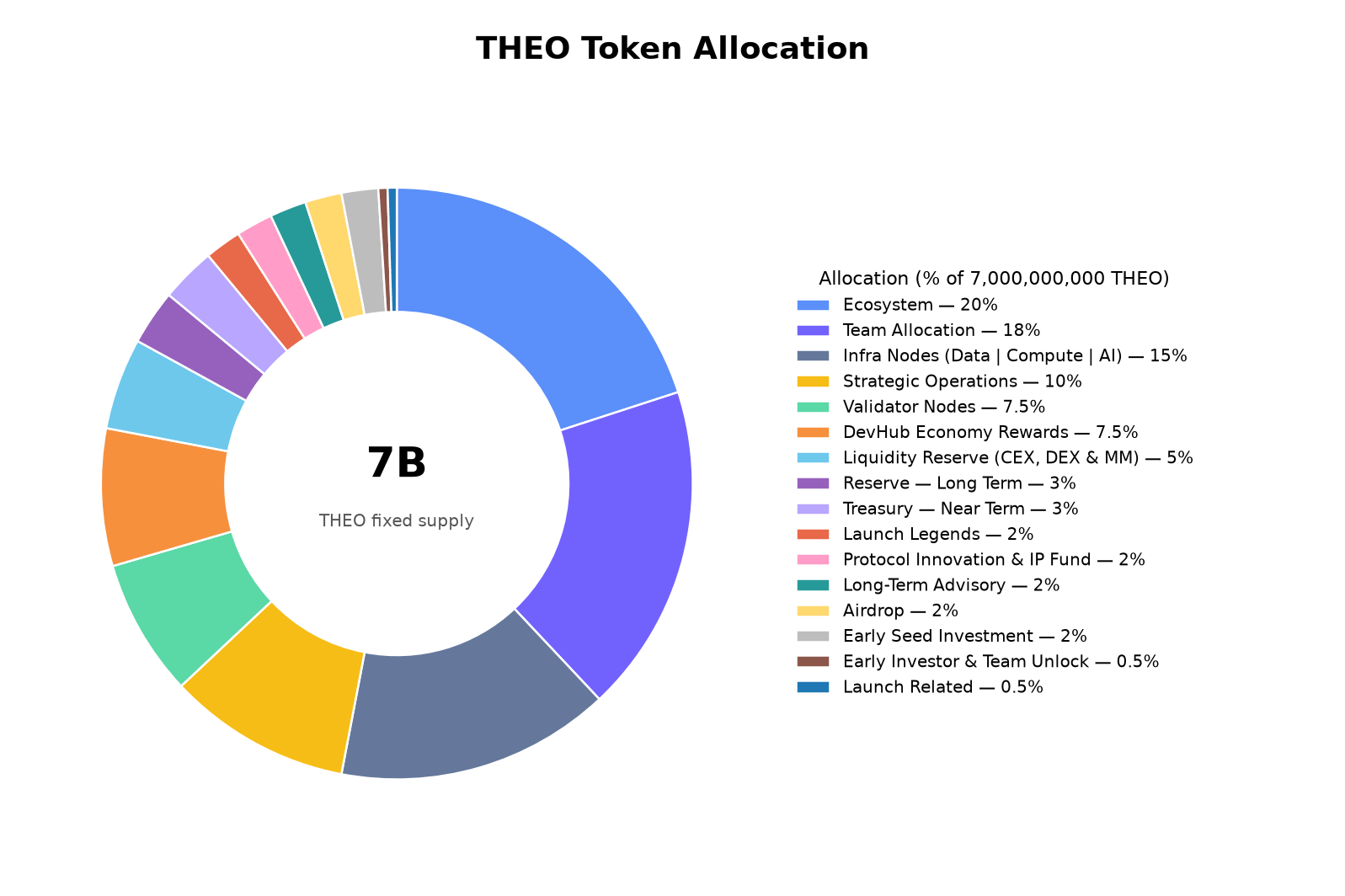
1.1 Initial circulation and vesting overview
Autheo’s token release strategy is structured to balance accessibility with sustainability. Early liquidity is provided to support exchange depth, validator onboarding, and ecosystem activation, while the majority of supply remains locked under extended cliffs and long-term vesting. This approach ensures alignment among contributors, investors, and builders, maintaining orderly market dynamics as the network scales. At launch (Token Generation Event, or TGE), approximately 5.3% of total supply (approximately 371,000,000 THEO) is available, made up of three components:Liquidity Reserve vs. Base-deployed liquidity — The 350,000,000 THEO figure represents the full Liquidity Reserve allocation, not the amount actively trading. As of launch, only 50,000,000 THEO has been bridged to Base and deployed for initial trading; the remainder of the Liquidity Reserve is not immediately entering the tradable market and will be deployed over time, as needed, to support additional market depth.
2. Emissions and circulating growth (10-year horizon)
Autheo’s token emission model is structured to balance network growth with long-term deflationary discipline. Rather than relying on perpetual inflation, THEO’s supply curve is front-loaded for expansion — driving validator onboarding, developer incentives, and infrastructure activation — then progressively transitions toward fee-funded sustainability through the Autheo Storage & Compute Fund (ASCF) and productive-deflation mechanisms. This ten-year schedule (August 2026 TGE through August 2036) defines the cadence by which cumulative supply enters circulation across three phases — Expansion, Scaling, and Maturity — aligning with key operational milestones in validator performance, DevHub engagement, and ecosystem maturity. Each phase compounds network productivity while simultaneously reducing dependency on inflationary issuance, creating a self-reinforcing liquidity cycle that supports compute and storage capacity. Adaptive parameters ensure the system remains resilient to market conditions. The emission policy begins within a controlled inflation band (~13% to ~10%) and can be refined by the Autheo Foundation and core development team within predefined limits. As ASCF reserves expand through transaction and compute fees, the share of emissions funded by inflation decreases correspondingly, sustaining validator and developer rewards through organic network activity.High-level schedule (phase milestones)
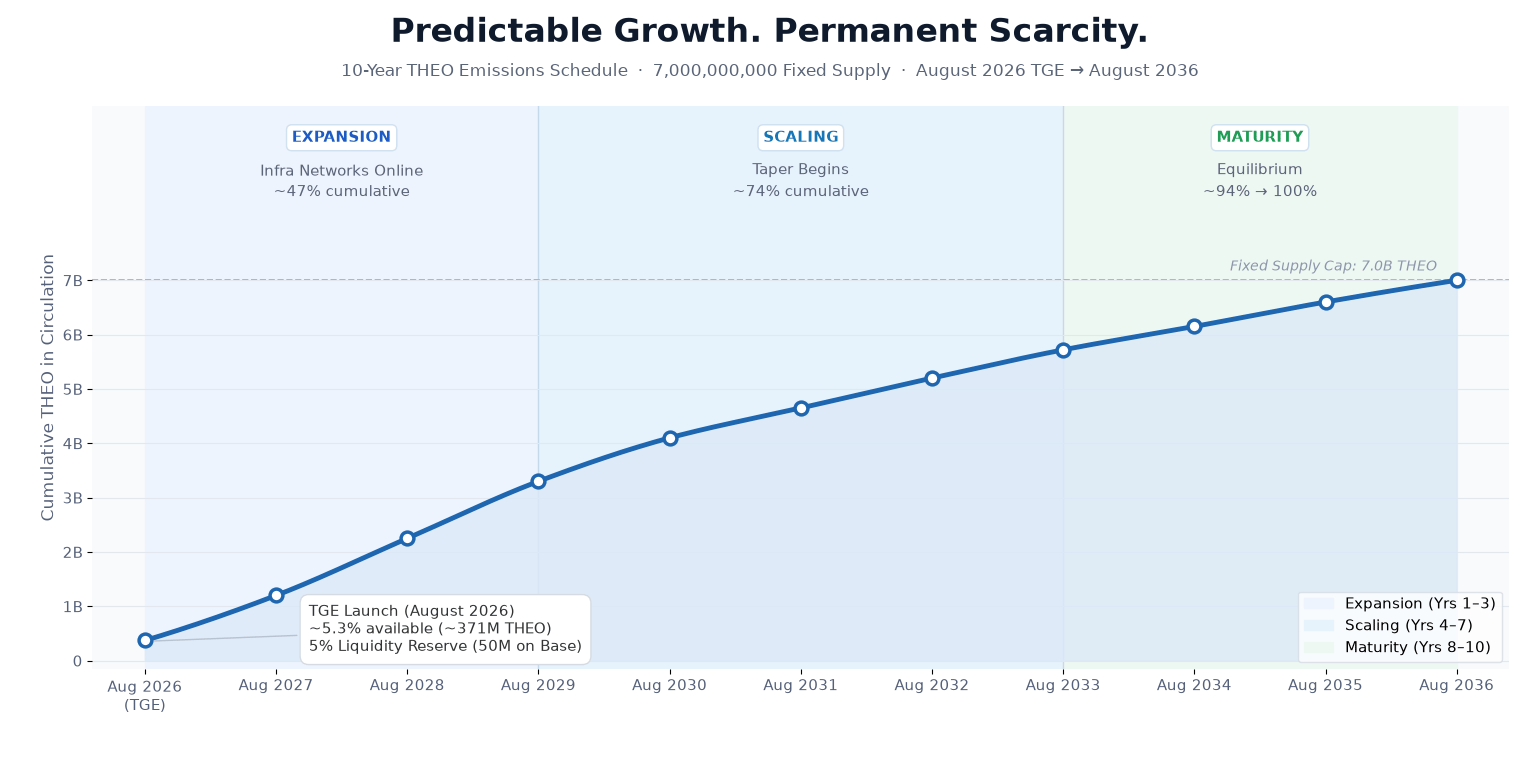
Autheo token emission and circulating growth (10-year horizon)The table and graph illustrate cumulative token release milestones across the Expansion, Scaling, and Maturity phases. As emissions taper, liquidity transitions from inflationary issuance to fee-backed reward circulation, maintaining continuous economic activity while converging toward the fixed 7,000,000,000 THEO supply cap.
- A dynamic emission curve tapers base inflation (~13% to ~10% band) as fee-backed reserves accumulate.
- Emission policy is administered by the Autheo Foundation and core development team, which can adjust it within predefined bands.
Tokenomics disclaimer — While we believe these figures represent accurate current estimates, all token allocations and emissions remain subject to change as Autheo finalizes its tokenomics and mainnet launch details.